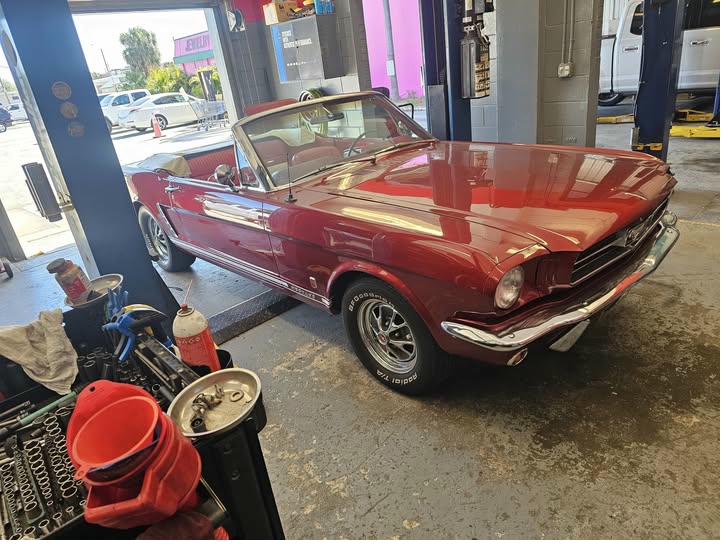
There's a reason the 1955–1957 Ford Thunderbird is called the "Little Bird" by enthusiasts, and there's a reason people still lose their minds over them at car shows. Something about those proportions — the low, sleek body, the porthole hardtop, the chrome trim — just works in a timeless way that modern car designers keep trying and failing to replicate.
I've been lucky enough to work on a beautiful powder-blue 1957 Thunderbird here in Vero Beach, and I've driven it, which gives you a different perspective on the car than just wrenching on it in the shop. These are real cars — not museum pieces — and they deserve to be driven and maintained with that in mind.
What Makes the '57 Special
The 1957 Thunderbird was the last of the two-seat T-Birds before Ford went to the larger four-seat "Squarebird" in 1958. Only 21,380 were built in 1957. The base engine was a 292 cubic inch V8, with optional upgrades to the 312 ci — some of which came with superchargers for serious performance. The 312 with twin four-barrel carburetors was rated at 270 horsepower, and the supercharged version pushed that to 300 or even 340 depending on the tune.
For 1957 specifically, Ford added fins to the rear quarters, giving the car an even more dramatic appearance. Wire wheel covers and porthole windows made it unmistakable. If you have a '57, you have something genuinely special.
The Y-Block V8: Understanding Ford's Unique Engine
The Ford Y-block V8 used in the '55-'57 T-Bird is a distinctive engine that requires specific knowledge to service correctly. The name comes from the deep, Y-shaped skirt on the block that extends below the crankshaft centerline. This makes for a stiff, strong block — but it also creates some quirks in how oil circulates and how certain maintenance procedures need to be performed.
Y-block engines are known to be prone to sludge buildup if oil changes are skipped or if the wrong oil viscosity is used. Using modern synthetic motor oil is fine, but you need to be thoughtful about the viscosity and the intervals. A Y-block that's been neglected will have oil passages that are partially restricted, which can show up as oil pressure problems or abnormal engine wear.
Valve train geometry is also specific to this engine. Setting valve lash correctly requires knowing the proper sequence and specifications — which aren't the same as other Ford engines from the era. Getting this wrong leads to noisy valves, poor performance, and accelerated wear.
Carburetor and Fuel System
The '57 T-Bird ran a Holley or Autolite carburetor depending on the engine configuration. These carburetors are genuinely rebuildable, and a proper rebuild — using correct jets, floats, and gaskets — restores function that deteriorates over decades of use. Modern ethanol fuel is particularly hard on vintage carburetor components, so we always recommend ethanol-compatible rebuild kits and careful attention to fuel line condition.
The mechanical fuel pump on these cars is another wear item. When the diaphragm fails — and it will eventually — you either lose fuel delivery entirely or get gasoline in your crankcase oil (a very bad situation). We check fuel pump condition during every service visit on a classic.
Suspension and Steering
The '57 Thunderbird uses a front suspension with ball joints that need to be checked periodically. Original ball joints from the 1950s are unlikely to still be in service, but even replacement parts age. Worn ball joints show up as front-end wander, tire wear, and a feeling that the car isn't tracking quite right. Steering box adjustment is also something that gets neglected on classics — a properly adjusted steering box makes these cars feel significantly more confidence-inspiring at highway speeds.
Driving and Enjoying Your Classic in Florida
Florida is actually a pretty great state for classic car ownership — no rust from road salt, mild winters, and a year-round show season. The trade-offs are the heat, the UV exposure (hard on rubber and paint), and the occasional violent summer rainstorm. If you're driving your T-Bird regularly in Vero Beach or around Indian River County, make sure the cooling system is in top shape, use a quality UV-resistant wax on the paint, and keep fresh rubber on the car — old tires are a safety issue regardless of tread depth.
For more on classic car care in our area, check out our classic car services page and our post on what it takes to service a 1954 Corvette. And if you've got a '57 Bird or any other classic in need of attention, give us a call at (772) 778-6929. These cars deserve the best care available, and we're committed to providing exactly that in Vero Beach.